- Lyricist
- Author
- Guitarist
- Poet
- Story Teller
Howdy, I’m Anthony.
If you ended up here, there’s a good chance you found one of my projects first and started pulling on the thread.
Behind the curtain, I’m a husband, a father, and a guy with ADHD who has spent most of his life building things.
I’ve been playing guitar for 26 years and programming for just as long. I’ve worked in science fiction publishing since 2011, reviewed more than 1,000 manuscripts, owned a video game bar, built and run a seven-figure marketing agency, and served as CTO of a nonprofit sending garden programs into third-grade classrooms across America.
My brain has accumulated a ridiculous amount of characters, riffs, stories, jokes, worlds, and strange ideas along the way.
Now I’m pouring all of it into Android 86.
For me, Android 86 isn’t just a band. It’s a growing creative universe built from music, storytelling, worldbuilding, emotion, aesthetics, and decades of ideas and obsessions that finally have somewhere to go.
Sometimes I take an idea and turn it into a single. Sometimes I take a larger story and build an entire album around it. It’s also the home of my upcoming book, Apocalypse System: Season One.
I write the stories and lyrics, compose the songs, record the guitars and bass, and make the final creative decisions behind Android 86.
AI is also part of my production workflow. I use it for vocals, drums, and production assistance, including vocal models built using samples of my own voice.
And that brings me to Lyra and Riot.
They’re not just characters in the upcoming book. They’re also the personas behind the vocals in Android 86, and each carries a very different energy, perspective, and creative intent.
Riot is built from samples of my own voice, modified and reshaped through an AI vocal workflow. When I write for Riot, I lean into something raw, ego-driven, aggressive, and sometimes a little mean. Riot is force, pain, defiance, obsession, and the part of the story that wants to kick the door in.
Lyra came from a complete accident. I was experimenting with voice modification on a human singer for another project, running the voice through filters and testing ideas, when this strange, unearthly voice appeared. It sometimes had this almost unnatural tuning baked into it, like it was arriving from somewhere else instead of being made.
When I write for Lyra, I do the opposite of what I do with Riot. I stop. I breathe. I let go of ego. I try to write from a more evolved perspective. Sometimes it honestly feels less like I’m writing for Lyra and more like Lyra is teaching me something while I’m trying to listen.
That duality is at the heart of Android 86.
A lot of what I make lives somewhere between heavy music, storytelling, technology, science fiction, dark humor, and whatever strange thing my brain decides is worth chasing next.
AI is one of the tools I use to make those ideas possible. The stories, concepts, lyrics, riffs, performances, direction, and final decisions come from me.
If any of that sounds interesting, follow along on your favorite platform and enjoy the ride.
Thanks for reading.
– Anthony
Every Android 86 song starts with a story.
Sometimes that story comes from research. Sometimes it comes from personal experience. Sometimes it comes from one of the strange ideas I’ve carried around, written down, or told people for years. Before I think about riffs, vocals, or production, I figure out what the song is really about: the scene, the character, the emotion, the conflict, and the world around it.
From there, I choose the sound that fits the story. Android 86 lives inside industrial metal, but that can mean a lot of different things. Some songs need to be gothic and cinematic. Some need to be extreme, violent, and chaotic. Some need to be minimal, cold, emotional, or strange. The story decides the subgenre.
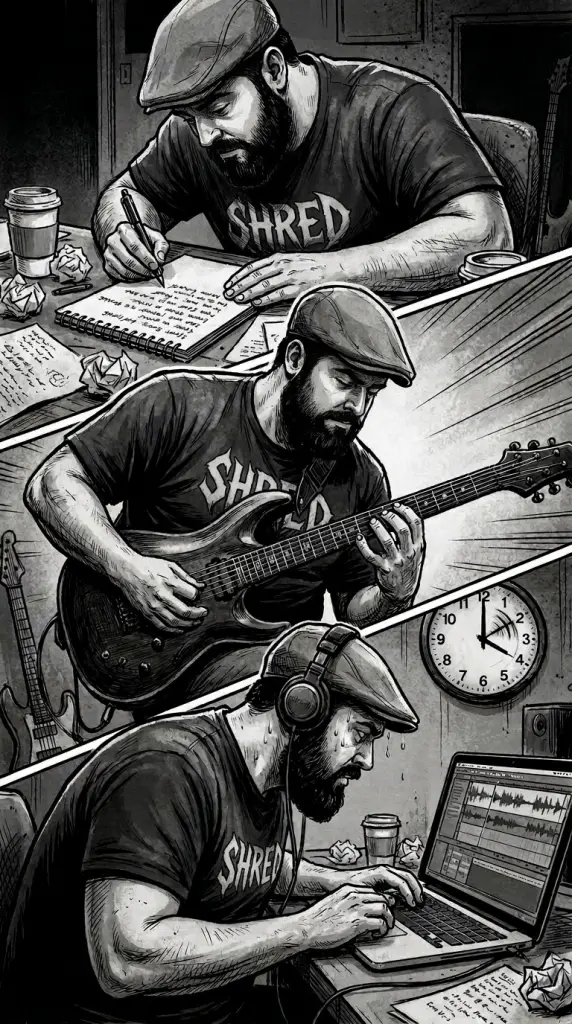
Once the direction is clear, I start writing riffs on bass or my 7-string guitar. Rhythm comes first. I want the song to have a physical shape before I build the rest of it. Then I write the lyrics, usually trying to make them feel like a compressed chapter from a larger world.
For vocals, I either sing the lines myself or use bass to map out the vocal movement. Then I train LYRA or RIOT using my own a cappella material. They are the vocal personas of Android 86, but they still need direction, structure, and a lot of correction. If they decide not to be divas, we move forward.
After that, I write the rest of the guitar and bass parts, build out the arrangement, and use AI-assisted tools to generate drums, textures, and FX that support the song. Then comes the cleanup. AI music tools are great at creating energy, but they are also great at creating mud, so I spend a lot of time fixing EQ, carving space, cleaning up the low end, and making the track hit harder.
Once the song is mixed, I live with it for a few days. I listen in the car. I listen at my desk. I listen until I know what is working and what is annoying me. During that same window, I work on artwork that matches the story.
Sometimes the song ends there. Sometimes the story keeps pulling at me. When that happens, it might grow into another song, an album, a blog post, or even a book.
That is the real process: story first, metal second, machines third, obsession always.