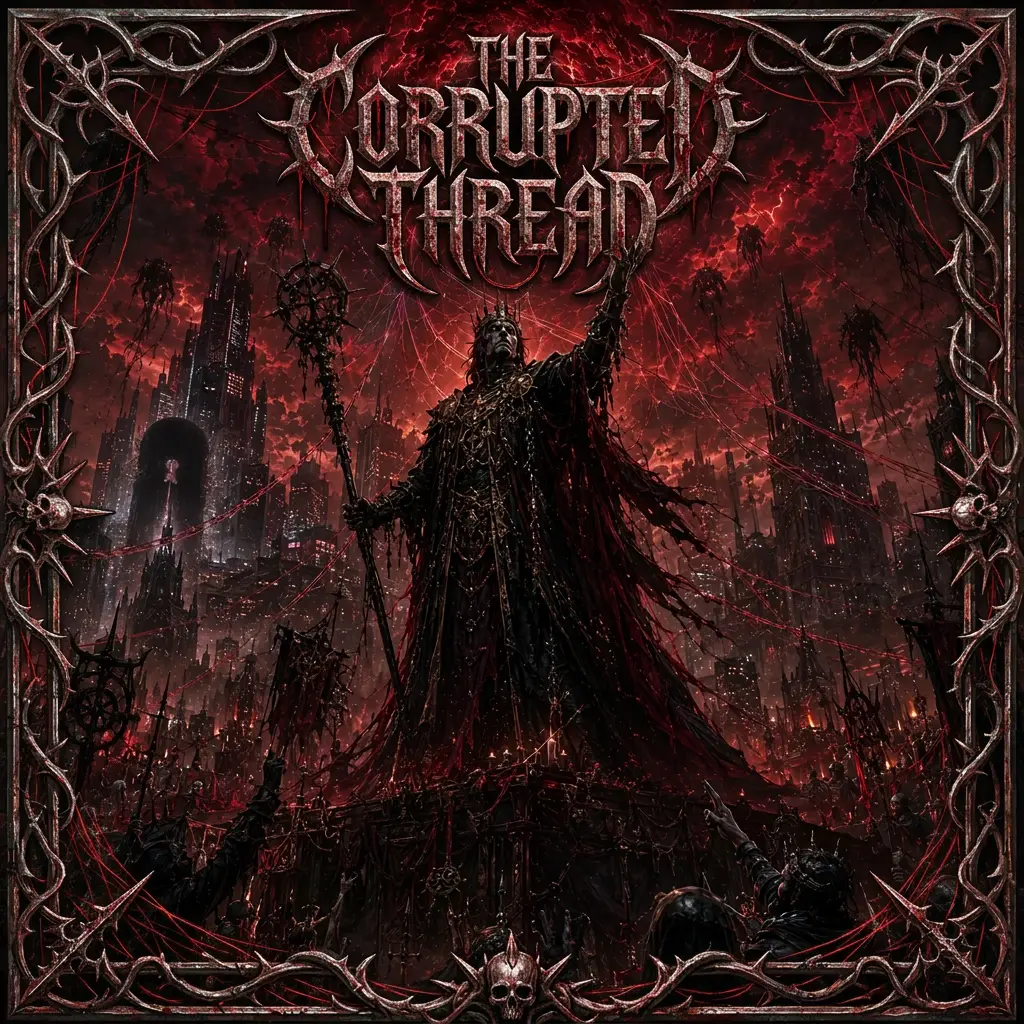
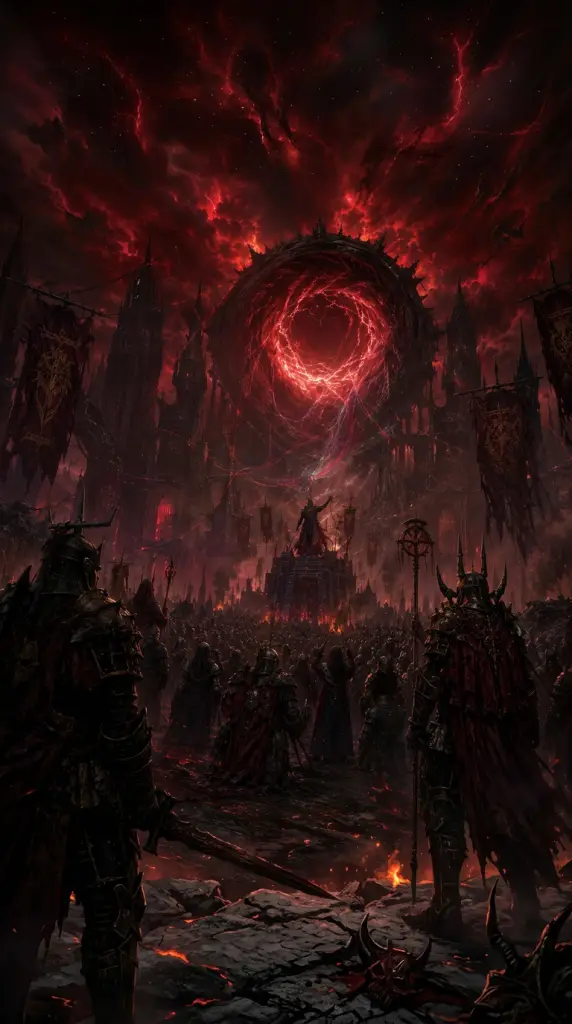
Hey there. This is a very long overdue post.
I spent so much time working on my latest album, The Corrupted Thread, that everything else fell behind: work, fatherhood responsibilities, promotion, all of it. I probably spent more than 300 hours on this album between the lyrics, the music, the studio work, and the constant cycle of banging my head against the same ideas until they finally worked.
By the time the album was ready, I did not even have room to write a proper blog post about it. I was so far behind that I had to work late on the following Friday’s single, Good Containers, and I barely got any promotion out at all.
So this post is me finally catching up. I want to talk about The Corrupted Thread, where it came from, how the story formed, and how much I genuinely love this piece of work. It might get a little meandery, but that is probably appropriate for an album about interdimensional threads.
Where the Album Came From
My original plan was to make Apocalypse System Season 2 as my second album. Like a lot of good plans, it did not quite work out.
I started writing a book for the first Apocalypse System album, and that book expanded the world much more than I expected. The story grew to the point where the album now connects to three separate books. Because of that, Apocalypse System is going on hold for a while as I explore that world properly and write the next two books.
But I did not want to stop creating albums. So I started looking at the stories behind some of my singles, and the one that felt like it still had a much larger story inside it was the Prince story.
That single was Prince of the Fallen World. It was inspired by a lot of things, including one very nerdy source: Vegeta, Prince of the Saiyans. Vegeta is one of my favorite childhood anime characters because he is all ego. In the Namek saga, he is pragmatic, practical, and potentially one of the strongest characters around, but his unrelenting ego keeps destroying him.
He makes rash decisions because he thinks he is better and stronger than he actually is. I enjoy his wins, but I also enjoy his losses because his ego brings those losses to him. He thought he could when he could not. That is a character archetype I really enjoy.
When I wrote Prince of the Fallen World, that kind of character became one of my main muses: a tragic, powerful figure who demands worship but also desperately needs help.
Serve me, hail me, make way, obey me.
Fight me, avoid me, stop me, save me.
That tension is the core of the prince: worship me, fear me, follow me, but also please save me. From there, I wanted to build a much larger story. The prince comes from a planet of interdimensional raiders, and that concept felt too cool to leave alone. That is where The Corrupted Thread really began.
Building an Eight-Track Concept Album
For The Corrupted Thread, I wrote an eight-track concept album where every song had a different job. I wanted the story to move in a linear way, but I did not want the story to clamp down on the music.
That was one of the lessons I took from Apocalypse System Season 1. I still love that album, but because I was so focused on telling a linear story, some of the songs ended up feeling similar to each other. With this album, I wanted the story to be clear while still leaving room for each song to stand on its own.
Musically, I also made a very specific choice: I used a 1980s-style piano throughout the whole album. That decision was inspired by Bruce Faulconer, the original composer for the American Dragon Ball Z score, who used a lot of piano in Vegeta’s theme. I wanted to pay tribute to that sound in my own way.
So the album has piano, fast guitar, tons of bass, and a lot of groovy movement. From there, the story opens up.
Track 1: Interdimensional Raiders
Interdimensional Raiders introduces the planet, the people, and the history behind their raids. It explains who they are, where they came from, and how they became the kind of civilization that sees portals not as an opportunity for discovery, but as an opportunity to take.
Infest, endure, conquest, we serve.
Bounty, we take, for our people’s sake.
Those opening lyrics set the tone immediately. This is an imperfect, war-torn population shaped by civil wars and survival. Then they get their chosen one: a metaphysical figure, almost a saint, who sees a purple thread and pulls on it with his soul.
That pull opens a portal. But instead of treating another world as a place for learning, exploration, or evolution, they look through and see resources. They see beautiful things. They see a place they can raid.
He led the soldiers through the gate
To clean pools under perfect skies.
Mud-caked boots and holy water.
Utopia learned to cry.
That breakdown is one of my favorite moments in the song. It tells the exact story I wanted: a brutal people stepping into paradise and ruining it. One of my favorite lines in the whole track is simple but, to me, very strong: We took all they had, and they had much.
By the end of the song, we have the planet, the people, their history, and the birth of our prince.
A new prince is born, all hail.
A new thread puller, all hail.
A new door waits, all hail.
A new world bleeds, all hail.
Track 2: Signal from Beyond
Signal from Beyond moves us forward. The prince is now an adult, and it is his responsibility to open the next gate for his people. His job is to find the next portal, lead the raiders through it, and bring back whatever they can take.
The intro gives away the whole tragedy in one sentence:
Misinformation and expectation, a recipe for extinction.
From there, we get the prince trying to fill his father’s shoes. He sees the threads. He asks himself how he will be different from those who came before him. He needs to be better than his father, better than his ancestors, and tall enough for everyone to see that he is enough.
I’ll lead the way, follow me.
I know the path, stay with me.
To gold isles and diamond shores.
Follow me, follow me, follow me.
I absolutely love that chorus because it comes from ego. The prince believes what he is saying. He is certain he can do better than all of them.
In the second verse, we see the political faces around him: sneering, bored, skeptical, jaded. He needs to prove himself to them. And then, of course, he picks the wrong thread.
He pulls it, and all the Cthulhu-like things pour through. It is not good. He made a mistake.
Out of the whole album, Signal from Beyond is probably the track I kept going back to the most. While I was waiting for the album to distribute, I listened to the full thing probably a hundred times on bike rides, car rides, and everywhere else. But Signal from Beyond kept pulling me back.
Track 3: The Black Invasion
The Black Invasion is the war song.
When I write music around battle or conflict, I usually like to let the listener use their imagination. I did that with The Huntress, where the song sits right before a major conflict without actually showing the battle. But for this album, I wanted to write the fight itself.
One big inspiration here was Ziltoid the Omniscient by Devin Townsend. That album handles conflict songs incredibly well. By Your Command and Planet Smasher have this forward momentum I have always loved, and I wanted The Black Invasion to carry some of that energy.
Lyrically, I wanted perspective. Some lines come from the soldiers, while others come from a narrator above the action. I wanted the point of view to shift as the battle unfolded.
This is also where I reuse the phrase Gods, Kings, Aliens, Demons from the first song. I love that line because if something comes from another dimension, what is it? It could be a god. It could be a king. It could be an alien. It could be a demon. It could be all of those things, or none of them.
But in The Black Invasion, the soldiers do not have time for philosophy. Gods, kings, aliens, demons: who gives a fuck? Push them out. Drive them back.
Hold the line, no retreat.
For the prince, for the king.
I also spent time thinking about what soldiers on this planet would say when they fight. That is where Vor-rah came from. It is a little tribute to Spartan-style battle chants, and it gave the soldiers something that felt like their own.
For a moment, we stem the tide.
For a moment, the banners rise.
For a moment, we stand tall.
For a moment, we watch them fall.
Vor-rah, Vor-rah, Vor-rah.
We are gods, we are war.
That is one of my favorite sections. They feel good about themselves because they have been winning for a long time. Then the verse ends with the sky splitting open and millions pouring through. Suddenly, it is very clear that this is not going to go well.
As the loss starts to sink in, a guitar riff appears halfway through the song. As we get closer to the end, that riff becomes stronger and more prominent. It is my way of musically telling the listener that they are losing and that a transition is coming. It is not necessarily a sad riff, but it is different from the rest of the song, and that was very much on purpose.
Track 4: Prince of the Fallen World
For Prince of the Fallen World, I took the original single and gave it a remix. The structure is basically the same, but I boosted the drums and bass guitar to give the track more presence on the album.
Lately, I have been doing more drum attack layering in my mixes. I create a copy of the drum layer, compress it heavily, drop the gain, and then blend it back into the song so the drums hit harder.
Part of that comes from working with AI drums. In the past, when I worked with my band, we could position microphones in different ways to shape the drum sound. Since these drums are synthetic, I have to create some of that impact in the mix. There are also parts where I use my keyboard for percussion, like war drums or specific effects. So it is a mix of AI and my own keyboard work, depending on what the song needs.
The main goal was simple: make the drums more present and let them cut through the mix. I think that has become a natural part of my evolution as a musician and producer. The older songs had drums, but the newer ones hit with more authority.
Story-wise, this track takes the prince from his ruined planet to Earth. By the end, he is walking around here, and he is not happy. That is the gist. I have talked about this song at length before, so I will not go too deep again here, but I still love it. When I put my songs on shuffle and this one comes on, I am always happy to hear it.
Track 5: Infrasonic
Infrasonic is the emotional break in the album.
On Apocalypse System, track five was also a more emotional piece and a break from the constant noise that metal can bring. I wanted to do something similar here: a slower song that takes the energy down for a moment.
I used a plucked cello plugin and a sustained dark cello plugin, and I built the song around a more minimal emotional space. The lyrics can work from the prince’s perspective, but they also come from a personal place.
When I was younger, I was forced to change schools. My attitude and emotional state caused me to isolate myself. There were people everywhere, but I put myself in a cage. I did not let myself make friends, and at the same time I resented the people around me for not approaching me, even though I was basically unapproachable.
That is a contradictory place to be emotionally. I can look back now and acknowledge that it was not healthy or good for me or anyone around me. I think a lot of people have felt some version of that.
For the prince, this becomes the experience of being on Earth, surrounded by people he has nothing to do with, the only one of his species, trapped in his own emotional state.
Fear grips my heart.
Shame dressed as anger.
That line is very strong to me because I have been there: feeling one thing, but having your body or mind push it out as something else.
I choose isolation in crowded streets.
People live their lives,
Blurry shapes in my vision.
Corrupted emotion pushes them away.
I intentionally kept the chorus short. Everything in the song needed to feel brief and abbreviated. I can be very wordy sometimes, but here I wanted minimalism.
So low, small, infrasonic.
Barely noticed, nothing here.
Unworthy, dead, infrasonic.
Out of focus, nothing here.
I love the word infrasonic for the same reason I love the word magnetostriction. It has a sci-fi quality, and people do not use it in daily conversation. It resonated with the feeling I was trying to describe: I am here, but you cannot hear me.
There is also a line that feels completely like the prince: Would I help me? No, I wouldn’t. That perspective is interesting to me. I can look back at my younger self and see a child being intentionally emotional and standoffish, and part of me thinks: I cannot help that person. That person has to get through it and grow.
I think Infrasonic has one of the highest listen rates because it is chill, and people love chill music. But for me, it is also one of the most personal songs on the album.
Track 6: Roaches Aren’t So Bad
My song title choices are ridiculous enough that I rarely have to worry about duplicates on Spotify. Roaches Aren’t So Bad is a perfect example.
At this point in the story, the prince has been on Earth for a while. He has had his sad time, and now he is observing humans. His conclusion is basically: you people are not so bad. But what he actually likes are humanity’s worst qualities.
That is the joke. He relates to the bad qualities. That is where the amusement of writing a character with an overinflated ego really starts coming through, especially in this song and the next one.
Musically, it is a bouncy, proggy metal song. Riot, my male vocal persona, sings this one. I sang the whole thing first and trained the vocal on how I wanted the delivery to feel, especially in the chorus.
They bite, I feast.
They swarm,
I lead.
I wanted that big pause before I lead, with the word lead stretching out before the song drops back into a more percussive delivery. I do that a lot with the Riot songs on this album: a sung-out line, then a rhythm-driven lyric section.
This song is meant to be a ride. I am poking fun at humans, the prince, and ego itself. It is a story about a flawed character liking humans for all the wrong reasons. By the final chorus, he has reached a dangerous conclusion: perhaps they deserve a prince.
That leads directly into the next track.
Track 7: I Started a Cult
For most of the album, I alternate between Lyra and Riot, my female and male vocal personas: track one female, track two male, track three female, track four male, track five female. But then I go male to male with Roaches Aren’t So Bad and I Started a Cult.
That was intentional because those two songs are basically part one and part two. We stay in the prince’s perspective as he looks at humanity, decides he should lead them, and then immediately proves that this is a terrible idea.
I Started a Cult is satire. It is over the top and silly, and I had a lot of fun writing it. The intro was inspired by the humor of a good friend of mine, the lead singer from a band I used to be in.
I corrected him once.
I’m not your god.
He smiled.
That’s exactly what a god would say.
That sets the tone. The prince starts gaining followers, and he cannot really stop them from following him. Things get out of hand quickly.
One became ten, ten became more.
Word spread quickly from shore to shore.
They bowed before me, eyes open wide.
Finally, a species with pride.
The chorus is intentionally dumb in the best way: I started a cult, look what I have done. Then we get another big sung-out line: They finally found a worthy one.
In verse two and the breakdown, I wanted things to stop going well for the prince. His followers start quoting him on things he never said. They claim he can raise the dead. They say he controls the rain. They argue about him. Then the breakdown has him yelling at a room full of cultists.
Stop writing scripture.
Who made these rules?
That whole section made me laugh while writing it. The rest of the song explores the flawed motivations behind the cult and ends with the prince enjoying his commands and imagining what he will do tomorrow.
Track 8: The Prince of Earth
For the final track, I wanted to change the point of view. Lyra narrates The Prince of Earth, and we see the prince from the outside now.
His cult has grown and grown. The whole world is looking up at him. His faithful are surging behind him, their voices shaking city walls. But the song also acknowledges that these are not perfect people. They are imperfect people with perfect faith.
The prince walked forward, head held high.
His faithful surged behind his stride.
Their voices shook the city walls.
Imperfect people, perfect faith.
Even the leaders of Earth are watching him now. The pre-chorus has him doing all the bowing and kneeling commands, and then the chorus becomes a callback to Signal from Beyond.
I love doing callbacks like that. I did something similar in Apocalypse System Season 1 with Assassin Revenge, where a line from one track returns later from another perspective. Here, the prince is still the one saying the words, but now we are hearing them through the narrator’s framing.
I’ll lead the way, follow me.
I know the path.
Now he has to prove he is worth following. His great power is opening portals, but he has never tried to do it on Earth. He promises golden crowns, rightful thrones, diamond shores, beautiful skies. The crowd asks him to show them he is divine.
So he reaches for his power. Everyone is watching. And that is when he realizes that on Earth, for whatever reason, all of the threads of color are draped in black and white. He cannot tell one thread from another.
The crowd is chanting. People are waiting. And this prideful, prideful prince lets his pride answer before he can think. He grabs the first thread he sees, pulls it, and rips it open.
The same squid-monster things from track two come through.
The portal opened, then hundreds.
The sky filled with wounds.
They came:
Endless mouths, endless limbs, endless hunger.
Every faithful screams. The rulers flee. Every eye turns toward the prince, waiting for a miracle.
Then Lyra gives this long note that I wanted to feel like a sung version of a frustrated sigh. And then the prince does exactly what the prince does.
The prince leapt toward the sky.
His ship answered.
And he never looked back.
What the Story Means to Me
The prince does not learn any lessons. He is still the same flawed character. He is going to go somewhere else, and maybe he will try the whole thing again.
That is the story I wanted to write: a character who is almost incapable of learning, surrounded by groups of people who are desperate for a leader even when that leader is obviously flawed. They follow charisma. They follow confidence. They follow someone who says he can do something.
We see that in life all the time. People follow leaders who promise they can do things, and then those leaders fail, leave, and abandon the people who lifted them up.
So yes, this is a sci-fi story about a flawed alien ego prince, portals, raiders, cults, and cosmic monsters. But it is also true in a very human way. He is just as bad as us.
I loved writing this story. I loved writing the music. I put a lot of time into The Corrupted Thread, and I think it is some of the best work I have released so far. It is another stepping stone toward creating more interesting music.
I hope you enjoy it. I hope you listen to it and find some of your own meaning in the lyrics. And I hope it gives you a nice little break while you are living your life.
Anyway, thanks for reading.